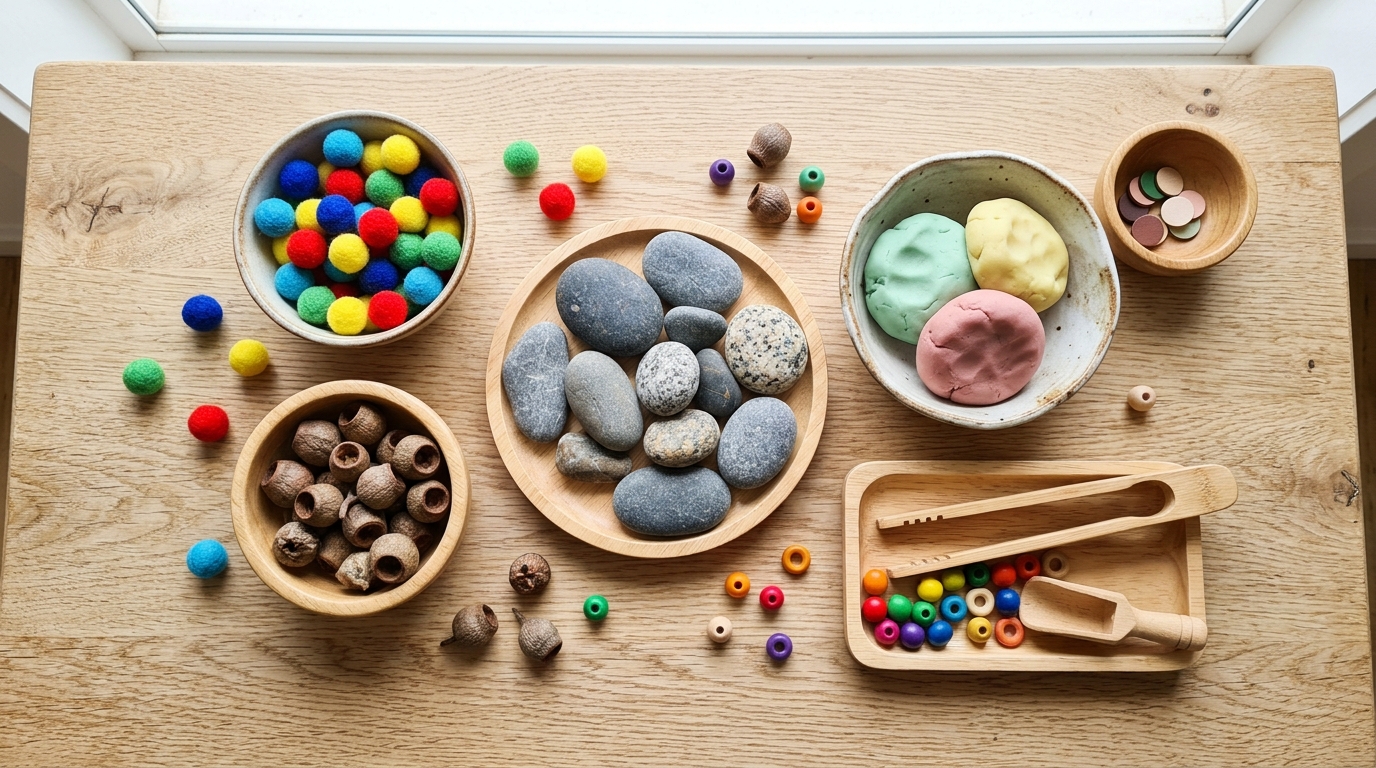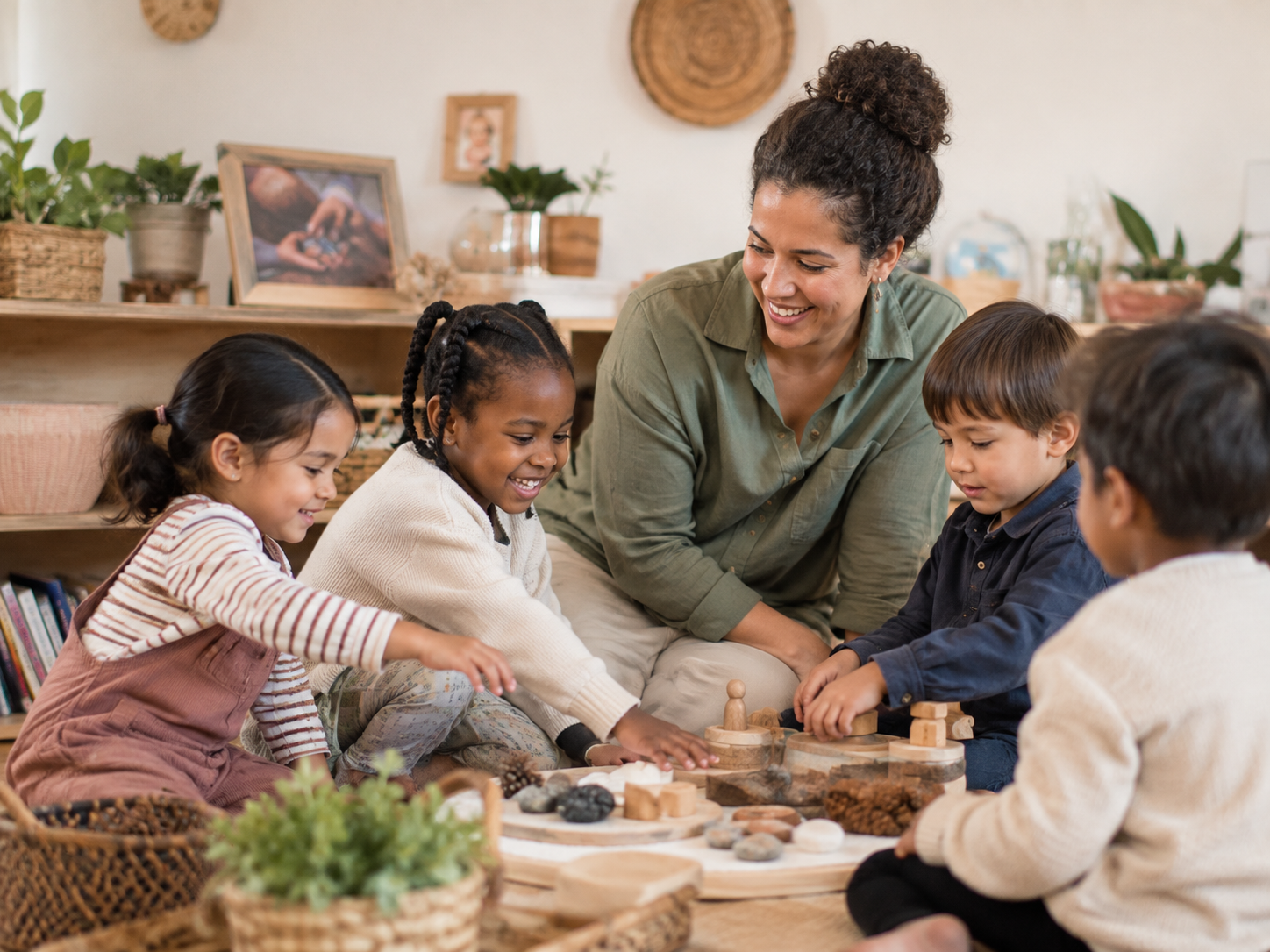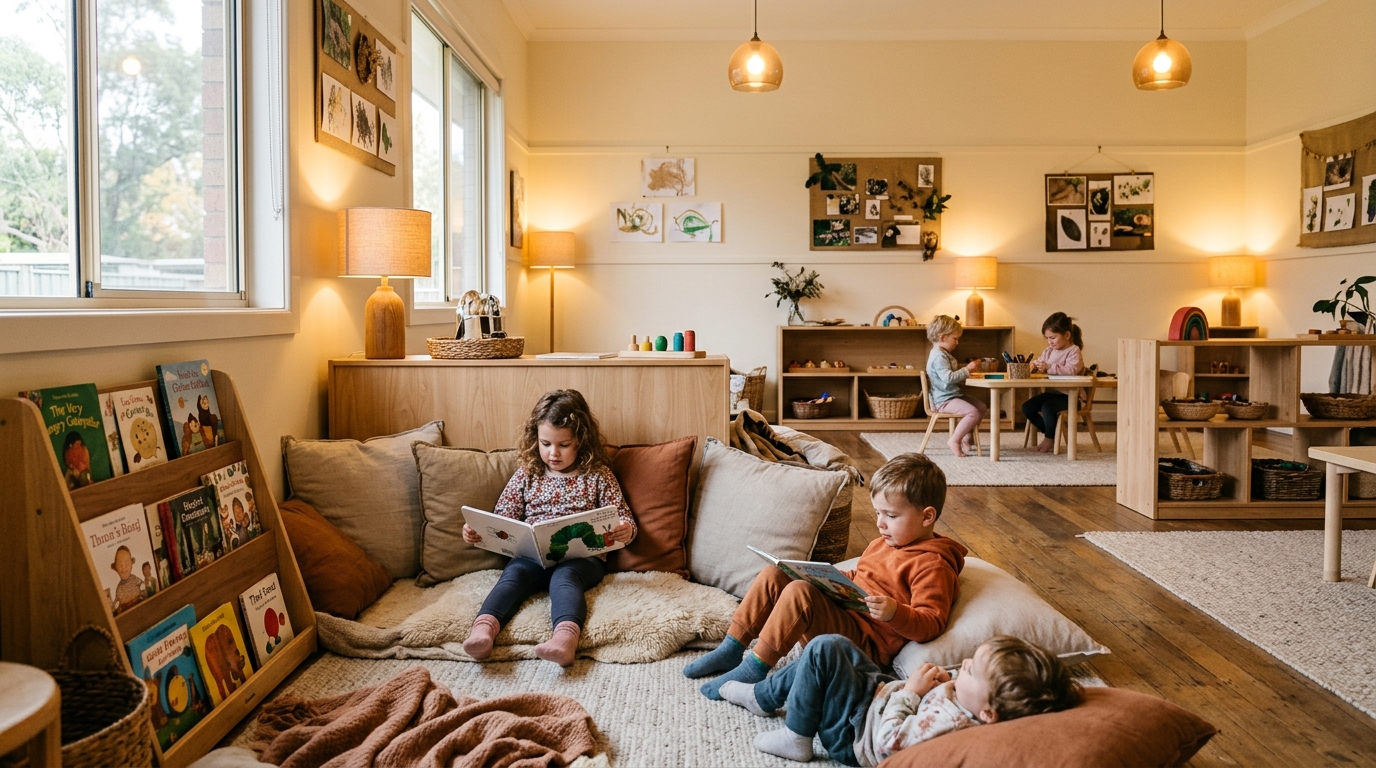
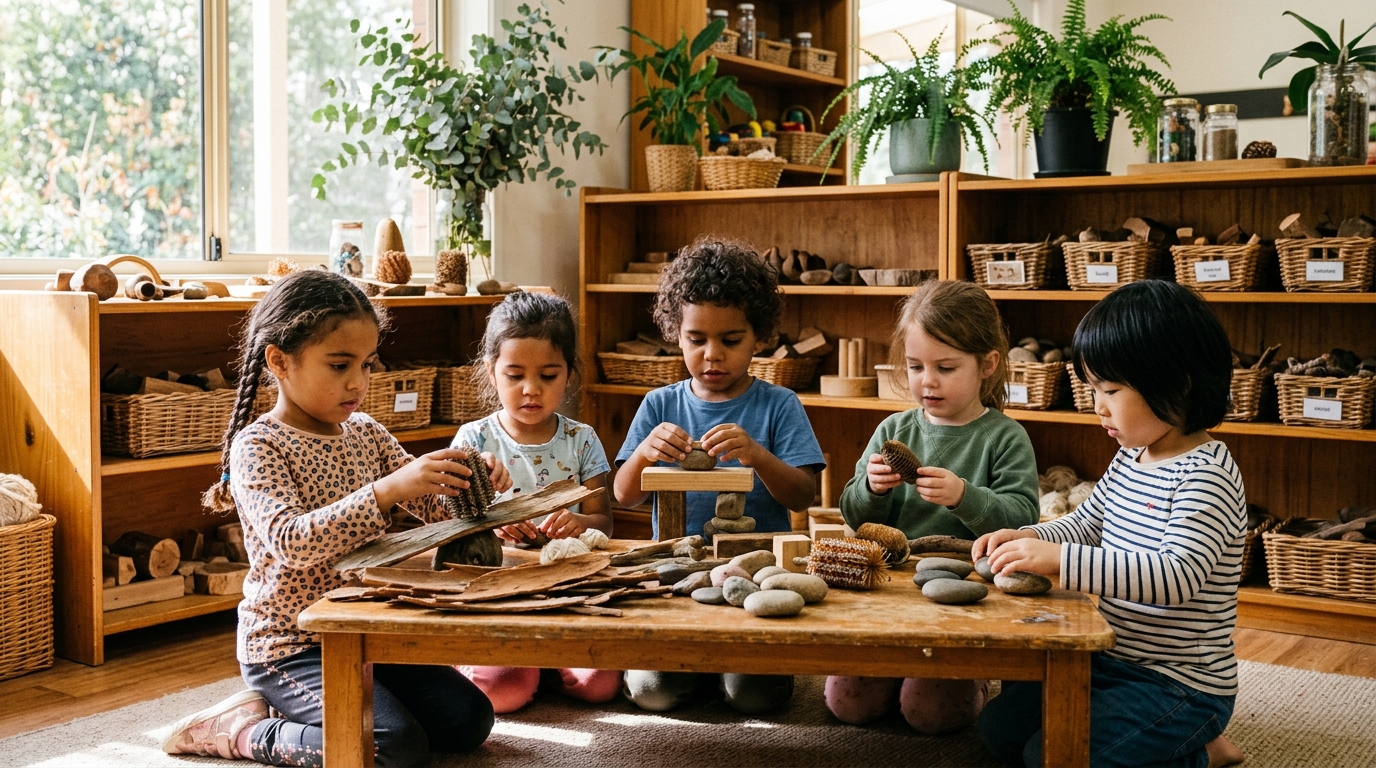
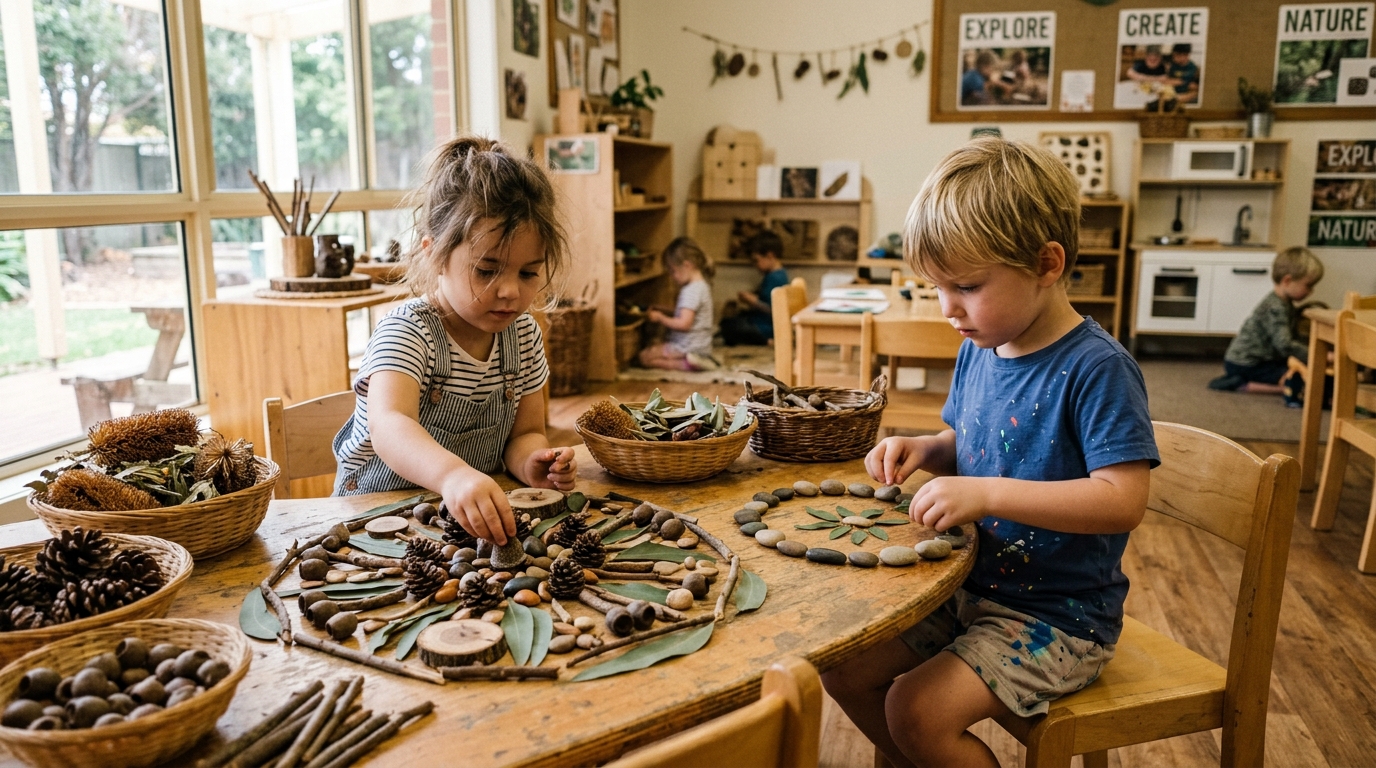
We all know the quiet magic that occurs when an educator places a basket of pinecones, river pebbles, and timber offcuts in front of a group of preschoolers. As early childhood professionals, we intuitively recognise its developmental value. But what is actually happening beneath the skull inside their developing brains?
When children manipulate sensory, open-ended materials, they are not simply passing time—they are physically constructing the neural architecture of their brains.
The Neuroscience of Open-Ended Play
During early childhood, the brain forms over 1 million new neural connections every second—a biological phenomenon termed synaptogenesis. Research from the Harvard Center on the Developing Child demonstrates that basic sensory pathways (touch, vision, proprioception) mature first, providing the neurobiological scaffolding upon which complex cognitive faculties and executive functions are later built.
Sensory Integration in Real Time
When a child balances a rough river stone atop smooth eucalyptus bark, their somatosensory cortex processes tactile textures while the cerebellum and motor cortex calibrate grip pressure and spatial orientation simultaneously.
Schema Play and Neural Reinforcement
What might appear to an observer as chaotic dumping or sorting is often neurological schema play (Athey, 1990). Repetitive actions—such as arranging items in lines or enclosing objects—reflect the brain physically hardwiring core spatial, physical, and mathematical models.
Mobilising the Prefrontal Cortex
Unlike single-purpose commercial toys with predetermined outcomes, loose parts present zero automated feedback. The child's prefrontal cortex must take charge: initiating working memory to hold a goal, exercising inhibitory control to resist premature demolition, and applying cognitive flexibility when a structure collapses.
**Foundational Research — Simon Nicholson (1971):** In his seminal Theory of Loose Parts, architect Simon Nicholson observed that 'in any environment, both the degree of inventiveness and creativity, and the possibility of discovery, are directly proportional to the number and kind of variables in it.' Nature provides the ultimate collection of non-standardised variables.
What the Evidence Tells Us: AERO & Play-Based Learning
The Australian Education Research Organisation (AERO) highlights that play-based learning generates optimal cognitive outcomes when environments are intentionally designed with high affordance materials. Natural loose parts have high affordance because their physical properties invite multiple actions: rolling, stacking, sorting, balancing, and transforming.
When educators step back from pre-determining the outcome, children experience what neuroscience identifies as self-directed discovery. This active problem-solving floods the brain's reward pathways with dopamine, cementing memory retention and fostering resilient learning dispositions.
3 Practical Steps for Busy ECTs to Elevate Loose Parts
Elevating loose parts from a tabletop activity to an engine of neural development requires educator intentionality and pedagogical restraint.
Step 1
Resist Premature Tidying: Recognise that transporting, tipping, and redistributing materials across the room are valid developmental investigations. Constant interruptions to 'put things back where they belong' short-circuit the child's unfolding neurological schema.
Step 2
Practise Intentional Pausing: When a child struggles to balance a pinecone on a sloped block, wait at least ten seconds before speaking. Over-scaffolding robs the child's prefrontal cortex of the crucial cognitive struggle needed to forge new synaptic connections.
Step 3
Use Open-Ended Provocations Over Instructions: Rather than directing children with 'Let's build a house,' pose open questions that provoke hypothesis testing: 'What do you notice about how these two pieces balance?' or 'How far can this line travel before it meets an obstacle?'
**EYLF V2.0 Connection (Outcome 4.2):** Children develop a range of learning dispositions such as curiosity, cooperation, confidence, creativity, commitment, enthusiasm, persistence, and imagination as they manipulate open-ended natural materials.
**Critical Reflection for Educational Leaders:** Look around your learning rooms today. What proportion of your tabletop resources are closed toys with a single 'correct' answer versus open-ended loose parts that demand genuine cognitive problem-solving?